


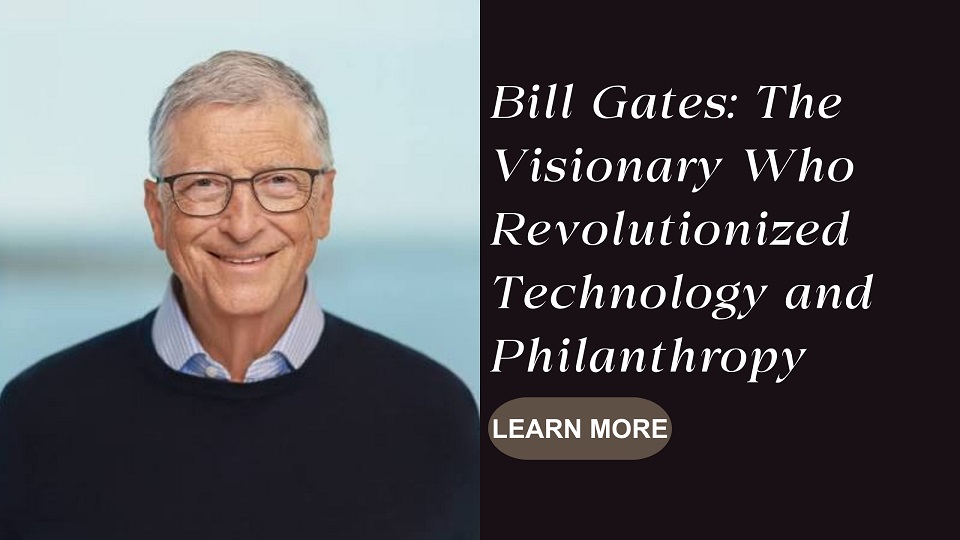
Quick Facts
| Category | Details |
|---|---|
| Full Name | William Henry Gates III |
| Age | 70 (as of 2026) |
| Date of Birth | October 28, 1955 |
| Height | 5’10” (1.78 m) |
| Weight | Approximately 65–70 kg (varies; historical resume listed 130 lbs / ~59 kg in youth) |
| Nationality | American |
| Profession | Businessman, software developer, investor, philanthropist |
| Estimated Net Worth | Around $100–150+ billion (fluctuates with markets; primarily Microsoft stock, investments, and Cascade Investment holdings) |
Bill Gates stands as one of the most influential figures of the modern era—not as a Hollywood actor, but as a pioneering technologist, entrepreneur, and philanthropist whose work reshaped how the world computes, communicates, and confronts global challenges. Co-founder of Microsoft, he helped bring personal computing into homes and offices worldwide, then redirected much of his fortune toward eradicating disease, improving education, and fighting climate change through the Bill & Melinda Gates Foundation. This biography explores his journey from a curious Seattle teenager to a global icon whose impact continues decades after he stepped back from day-to-day Microsoft leadership.
Table Of Content
Early Life and Family Background
William Henry Gates III was born on October 28, 1955, in Seattle, Washington, into a prominent family that valued achievement and intellectual curiosity. His father, William Henry Gates Jr. (often called Bill Gates Sr.), was a successful attorney, while his mother, Mary Maxwell Gates, was a schoolteacher who later became a strong community leader and board member of organizations including United Way. The family lived in the Sand Point area of Seattle. Gates has two sisters, Kristi and Libby.
From an early age, Gates showed intense focus and competitive drive. He was small for his age and experienced bullying, yet the household encouraged games, debates, and excellence—whether in cards, sports, or academics. A rare tornado damaged the family home when he was seven, an event that later appeared in family stories. His parents recognized his restless energy and intellectual gifts; when he underperformed in a public school setting, they enrolled him at the elite Lakeside School, a decision that would prove pivotal.
At Lakeside in the late 1960s, Gates encountered computers for the first time. Access to a Teletype terminal connected to a time-sharing system sparked an obsession. He and classmates, including future Microsoft co-founder Paul Allen, spent countless hours programming, exploring code, and even finding ways to extend their computer time. This early immersion in software laid the foundation for everything that followed. Gates has reflected in later years, including in his 2025 memoir Source Code, on aspects of his neurodivergence and the intense focus that defined his youth.
Education
Gates attended Lakeside School, where his programming skills flourished. He scored highly on standardized tests and entered Harvard University in 1973. At Harvard he studied mathematics and computer science but found the formal curriculum less compelling than practical computing. He continued collaborating with Paul Allen remotely and explored opportunities in the emerging microcomputer industry.
In 1975, after seeing an article about the Altair 8800 microcomputer, Gates and Allen contacted Micro Instrumentation and Telemetry Systems (MITS) about writing software for it. Their success with a BASIC interpreter led Gates to leave Harvard that year without completing his degree—a decision that became legendary in tech lore. He has often noted that the practical experience of building software outweighed remaining in formal academia at that moment.
Career Journey: From Microsoft to Global Philanthropy
Gates co-founded Microsoft (originally Micro-Soft) with Paul Allen in 1975 in Albuquerque, New Mexico, later relocating to the Seattle area. The company’s early breakthrough came through licensing MS-DOS to IBM for its personal computer in 1980–1981. This deal positioned Microsoft as the dominant supplier of operating systems for the exploding PC market. Windows, launched in the mid-1980s and refined through subsequent versions, became the graphical interface that defined personal computing for hundreds of millions of users.
Under Gates’s leadership as CEO, Microsoft expanded aggressively into applications (Word, Excel, PowerPoint via the Office suite), networking, and later internet technologies. The company faced significant legal challenges, including a major U.S. antitrust case in the late 1990s that scrutinized its market practices. Gates stepped down as CEO in 2000, handing the role to Steve Ballmer while remaining chairman and chief software architect. He gradually reduced his day-to-day involvement, fully transitioning away from regular Microsoft duties by the 2010s while retaining a board role for a period and remaining a major shareholder.
Beyond Microsoft, Gates co-founded Cascade Investment and has been involved in numerous technology and energy ventures. His career pivot toward philanthropy accelerated in the 2000s. With Melinda French Gates, he established the Bill & Melinda Gates Foundation, which has become one of the world’s largest private foundations. Its work focuses on global health (vaccines, malaria, polio eradication efforts), poverty alleviation, education reform in the United States, and later climate and energy innovation. Gates has written books including The Road Ahead, Business @ the Speed of Thought, How to Avoid a Climate Disaster, and more recently Source Code, sharing insights on technology, business, and personal beginnings.
Major achievements include transforming personal computing from a hobbyist pursuit into an everyday tool, creating enormous economic value and employment, and channeling tens of billions of dollars into evidence-based global development. Awards and recognition have been numerous: he has received honorary degrees, the Presidential Medal of Freedom, and various technology and humanitarian honors. Microsoft itself became one of the most valuable companies in history under the foundation he helped build.
Personal Life, Lifestyle, and Family
Gates married Melinda French in 1994. The couple has three children: Jennifer, Rory, and Phoebe. They announced their divorce in 2021 after 27 years of marriage and have continued collaborative work through the foundation in adjusted capacities. Gates has spoken publicly about the importance of family, reading, and continuous learning. His lifestyle reflects both the resources of extreme wealth and a longstanding interest in practical problem-solving—whether through technology, agriculture, or energy systems.
He is known for an intense work ethic in earlier decades, a passion for reading (often sharing book lists), and investments in large-scale projects such as nuclear energy innovation and agricultural productivity. Physical details from public records and older resumes note a height of approximately 5’10” and a relatively slight build in youth. In later years he has discussed health, fitness, and the importance of sleep and focus. Gates has also been open about personal traits, including color blindness and reflections on autism spectrum characteristics in his writing.
Net Worth and Income Sources
Bill Gates’s net worth has fluctuated with Microsoft’s stock performance, diversification through Cascade Investment, and large philanthropic transfers. Estimates commonly place it in the range of roughly $100–150 billion in recent years, though exact figures vary by source and market conditions. Primary sources of wealth include residual Microsoft holdings (he has sold or transferred substantial shares over time), diversified investments managed through Cascade (spanning real estate, energy, transportation, and other sectors), and returns from earlier equity stakes. Philanthropy has involved giving away tens of billions, consistent with the Giving Pledge he co-initiated with Warren Buffett and others. Income historically derived from Microsoft executive compensation, dividends, stock sales, and investment returns rather than traditional salaries in later decades.
Physical Appearance and Fitness
Standing about 5’10” (1.78 m), Gates has maintained a relatively lean frame consistent with historical descriptions. Public appearances over decades show the transition from the intense young programmer of the 1970s–80s to the more measured public figure of later years. Fitness details are not heavily publicized, though he has emphasized practical habits around energy, travel, and sustained intellectual work rather than athletic celebrity.
Interesting Facts About Bill Gates
- He wrote his first software program as a teenager at Lakeside School and co-founded Microsoft while still in his early twenties.
- An early résumé listed his height as 5’10”, weight as 130 pounds, and a desired salary as “open.”
- He purchased the Codex Leicester, a collection of Leonardo da Vinci’s scientific writings, in 1994.
- Gates has described himself as competitive from childhood and has reflected on neurodivergence in recent writing.
- Despite leaving Harvard without a degree, he has received numerous honorary doctorates and remains one of the most recognized self-taught success stories in technology.
- He co-founded the Giving Pledge, encouraging billionaires to commit the majority of their wealth to philanthropic causes.
- His foundation’s work has contributed to major reductions in child mortality and progress against diseases such as polio and malaria in many regions.
Conclusion
Bill Gates’s impact extends far beyond software. By helping make personal computing ubiquitous, he accelerated the information age; by dedicating vast resources and attention to global health, education, and climate, he has sought to address some of humanity’s hardest problems with the same analytical intensity he once applied to code. At 70, he continues writing, investing in innovation, and advocating for science-based solutions. His future prospects remain tied to philanthropy, technology advising, and the long-term outcomes of the institutions and ideas he has shaped. Whether measured in lines of code, lives improved, or systems transformed, Gates’s legacy is one of ambition matched by sustained execution—an enduring example of how technical skill and large-scale giving can influence the world.
FAQ
How old is Bill Gates? Bill Gates was born on October 28, 1955, making him 70 years old as of 2026.
What is Bill Gates’s net worth? Estimates typically range from roughly $100 billion to over $150 billion depending on market conditions and valuation methods, primarily from Microsoft-related wealth and diversified investments after significant philanthropic giving.
What is Bill Gates famous for? He is best known as the co-founder of Microsoft, the company that popularized personal computing software (MS-DOS, Windows, Office), and as a leading global philanthropist through the Bill & Melinda Gates Foundation.
What is Bill Gates’s family background? He was born in Seattle to attorney William H. Gates Jr. and community leader Mary Maxwell Gates. He has two sisters and three children from his marriage to Melinda French Gates (divorced 2021).
Did Bill Gates finish college? He attended Harvard University from 1973 to 1975 but left to build Microsoft full-time and did not complete a bachelor’s degree, though he has received many honorary degrees.
This article draws on widely reported biographical details to present an accurate portrait of Bill Gates’s life and contributions.