


Quick Facts
Charlie Chaplin, born Sir Charles Spencer Chaplin Jr., was one of the most influential figures in the history of film. He was born on April 16, 1889, in London, England, and passed away on December 25, 1977, at the age of 88. Standing at approximately 5 feet 5 inches (165 cm) tall and weighing around 130–140 pounds (59–64 kg) during his prime, Chaplin possessed a compact frame that became iconic through his on-screen persona. He held British nationality by birth and later became a naturalized citizen of the United States, though he spent his final years in Switzerland. As an actor, filmmaker, composer, and producer, Charlie Chaplin built an estimated net worth of $400 million at the time of his death (adjusted for inflation), making him one of the wealthiest entertainers of the silent film era. His profession spanned over seven decades, during which he revolutionized comedy, storytelling, and the art of filmmaking itself.
Table Of Content
- Quick Facts
- Introduction: Why Charlie Chaplin Is Famous
- Early Life and Family Background
- Education and Training
- Career Journey: From London Stages to Global Stardom
- Early Career in Vaudeville
- Breakthrough: The Birth of the Tramp
- The Mutual and First National Years
- Major Films and Masterpieces
- Later Career and Legacy
- Personal Life, Lifestyle, and Family
- Physical Appearance and Fitness
- Net Worth and Income Sources
- Interesting Facts About Charlie Chaplin
- Frequently Asked Questions (FAQ)
- Conclusion: The Enduring Legacy of Charlie Chaplin
Introduction: Why Charlie Chaplin Is Famous
Charlie Chaplin is famous not merely because he made people laugh—he fundamentally transformed the way the world experienced cinema. In an era when films were silent and storytelling relied entirely on visual expression, Chaplin created a character so universally beloved that it transcended language, culture, and class. His iconic “Tramp” persona, with its bowler hat, toothbrush mustache, oversized shoes, and cane, became a symbol of human resilience and dignity in the face of adversity.
What sets Charlie Chaplin apart from his contemporaries is the extraordinary depth he brought to comedy. While others focused on slapstick gags, Chaplin infused his films with social commentary, pathos, and profound humanism. He was a master of physical comedy, yes, but he was also a brilliant writer, director, composer, and producer who maintained complete creative control over his work at a time when the studio system dominated Hollywood. Charlie Chaplin didn’t just act in films—he was cinema for an entire generation, and his influence continues to shape filmmakers, actors, and artists around the globe.
Early Life and Family Background
Charlie Chaplin’s early life was marked by poverty, hardship, and instability—experiences that would deeply inform the empathetic, working-class themes of his greatest films. He was born in Walworth, London, to Hannah Chaplin and Charles Chaplin Sr., both of whom were music hall entertainers. His father was a singer and actor, while his mother was a talented vocalist and actress who performed under the stage name Lily Harley.
Tragedy struck early in Charlie Chaplin’s life. His parents separated when he was very young, and his father provided little financial support. More devastatingly, his mother Hannah struggled with severe mental health issues and was eventually committed to mental asylums for extended periods. During these times, Charlie and his older half-brother Sydney Chaplin were left to fend for themselves, often spending time in workhouses and orphanages—the grim Victorian institutions for the poor.
At the age of seven, Charlie Chaplin made his first stage appearance when his mother lost her voice during a performance and he was pushed onstage to substitute. The audience loved him, and a star was born in the most unlikely of circumstances. These formative experiences of poverty, separation, and performance gave Charlie Chaplin an extraordinary emotional range and an unshakable connection to the struggles of ordinary people.
Education and Training
Charlie Chaplin received very little formal education. Like many children from impoverished backgrounds in Victorian England, his schooling was sporadic at best. He attended various schools in London but was frequently pulled out due to financial instability and the need to contribute to his family’s survival.
His real education came from the stage. At age nine, he joined a touring troupe called The Eight Lancashire Lads, a clog-dancing group that performed across England. This early training in physical comedy, timing, and audience engagement proved invaluable. By his teenage years, Charlie Chaplin had developed into a skilled performer, landing roles in West End productions and honing the precise physical comedy that would later define his film career.
Career Journey: From London Stages to Global Stardom
Early Career in Vaudeville
Charlie Chaplin’s professional career began in earnest when he joined Fred Karno’s prestigious comedy company in 1908. Karno was the leading producer of slapstick comedy in England, and his company served as a training ground for many future stars. Chaplin quickly became one of Karno’s standout performers, known for his impeccable timing and ability to improvise.
In 1910, the Karno company toured the United States, and American audiences were captivated by the young English comedian. Two years later, in 1912, Chaplin returned to America for a second tour. This time, his performance caught the attention of film producers from the Keystone Film Company, who offered him a contract to work in motion pictures.
Breakthrough: The Birth of the Tramp
Charlie Chaplin made his film debut in 1914 with Making a Living, but it was his second film, Kid Auto Races at Venice, that introduced the world to the character who would make him immortal: the Tramp. Dressed in baggy pants, a tight coat, a bowler hat, and oversized shoes, with a cane and a toothbrush mustache, the Tramp was an instant sensation.
What made the Tramp extraordinary was his duality—he was a vagrant, yet he carried himself with the dignity of a gentleman. He was clumsy, yet graceful. He was poor, yet generous. This character resonated with audiences because he embodied the struggles and hopes of the common man in an rapidly industrializing world.
The Mutual and First National Years
Charlie Chaplin’s popularity exploded throughout the 1910s. He moved from Keystone to Essanay Studios in 1915, then to Mutual Film Corporation in 1916, where he produced some of his most beloved short films, including The Immigrant, Easy Street, and The Adventurer. By 1918, he was one of the most famous people on Earth.
In 1919, along with D.W. Griffith, Mary Pickford, and Douglas Fairbanks, Charlie Chaplin co-founded United Artists, a revolutionary move that gave artists control over their own work and distribution. This decision demonstrated Chaplin’s commitment to creative independence and set the stage for his greatest achievements.
Major Films and Masterpieces
Charlie Chaplin’s feature-length films represent some of the finest achievements in cinema history:
- The Kid (1921): His first feature film, blending comedy with genuine emotion and featuring a remarkable performance by child actor Jackie Coogan.
- The Gold Rush (1925): Often considered his greatest silent film, featuring iconic scenes like the “dance of the rolls” and the Thanksgiving dinner of boiled boots.
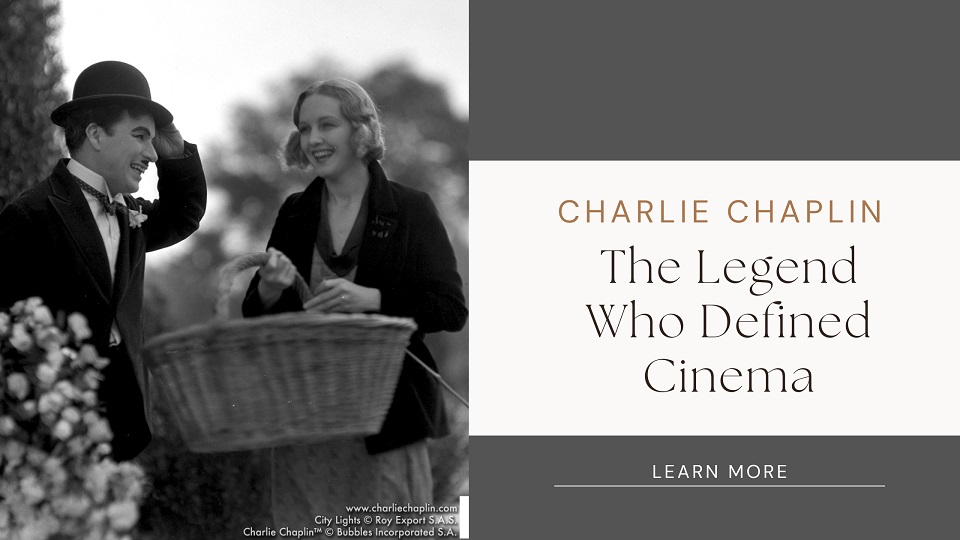
- City Lights (1931): A silent film made after the advent of “talkies,” it is widely regarded as one of the greatest films ever made, with its perfect balance of laughter and tears.
- Modern Times (1936): A satirical masterpiece about the dehumanizing effects of industrialization, featuring the Tramp’s final appearance.
- The Great Dictator (1940): Chaplin’s first true sound film and his most overtly political work, a brave satire of Adolf Hitler and fascism. His final speech, calling for peace and humanity, remains one of cinema’s most powerful moments.
- Monsieur Verdoux (1947): A dark comedy about a serial killer, inspired by the real-life murderer Henri Désiré Landru. It was controversial but is now recognized as a brilliant work of social criticism.
- Limelight (1952): A deeply personal film about an aging music hall performer, featuring Chaplin’s only on-screen collaboration with Buster Keaton.
Later Career and Legacy
Charlie Chaplin’s later years were complicated by political controversy. During the McCarthy era, his left-leaning political views and refusal to become an American citizen made him a target. In 1952, while traveling to London for the premiere of Limelight, he was informed that he would not be allowed to re-enter the United States unless he submitted to an interview about his political views. Chaplin chose exile, settling in Vevey, Switzerland, with his family.
He made two more films—A King in New York (1957) and A Countess from Hong Kong (1967)—but his creative peak had passed. However, in 1972, he returned to the United States to receive an honorary Academy Award for his incalculable contribution to film. The 12-minute standing ovation he received remains the longest in Oscar history.
Personal Life, Lifestyle, and Family
Charlie Chaplin’s personal life was as dramatic as his films. He was married four times and fathered eleven children. His marriages were often controversial due to significant age differences:
- Mildred Harris (1918–1921): Chaplin’s first wife, an actress, was 16 when they married. They had one son who died in infancy.
- Lita Grey (1924–1927): His second wife was also 16 at marriage. They had two sons, Charles Chaplin Jr. and Sydney Chaplin.
- Paulette Goddard (1936–1942): An actress who starred alongside him in Modern Times and The Great Dictator. Their relationship was more equal and modern.
- Oona O’Neill (1943–1977): His final marriage, to the daughter of playwright Eugene O’Neill, was his happiest and most enduring. Despite a 36-year age gap (Oona was 18, Chaplin 54), they remained devoted until his death and had eight children together, including actress Geraldine Chaplin.
Despite his immense wealth, Charlie Chaplin lived relatively simply in his later years, preferring the quiet life in Switzerland with his family. He was known for his perfectionism, often shooting hundreds of takes to get a scene exactly right. He was also an accomplished musician, composing the scores for most of his films, including the iconic song “Smile,” which became a standard recorded by countless artists.
Physical Appearance and Fitness
Charlie Chaplin stood at approximately 5 feet 5 inches (165 cm) and maintained a lean, wiry build throughout his career, weighing roughly 130–140 pounds (59–64 kg). His compact frame was actually an asset in physical comedy, allowing him to perform acrobatic stunts, pratfalls, and graceful movements with remarkable agility.
In his youth, Chaplin was known for his athleticism. He performed many of his own stunts and maintained his fitness through constant physical activity on set. His famous walk—a distinctive waddle with feet turned outward—was carefully choreographed and became one of the most recognizable gaits in entertainment history.
As he aged, Chaplin’s appearance changed naturally, though he maintained a distinguished presence. In his later years, he abandoned the Tramp mustache and appeared as a distinguished gentleman with white hair, though his expressive eyes retained the same warmth and intelligence that had captivated audiences for decades.
Net Worth and Income Sources
At the time of his death in 1977, Charlie Chaplin’s estimated net worth was approximately $400 million when adjusted for inflation. His wealth came from multiple sources:
- Film Salaries: During his peak, Chaplin was one of the highest-paid entertainers in the world. His 1916 contract with Mutual paid him $670,000 per year (equivalent to roughly $18 million today).
- United Artists: As a co-founder, he earned substantial profits from distribution.
- Ownership of His Films: Unlike most actors of his era, Chaplin owned the rights to his films, generating enormous revenue from re-releases, television broadcasts, and licensing.
- Music Royalties: His compositions, particularly “Smile,” continued to generate income long after his death.
- Real Estate: He owned properties in Hollywood, Switzerland, and other locations.
Today, the Chaplin estate continues to manage his intellectual property, ensuring that his legacy remains financially and culturally significant.
Interesting Facts About Charlie Chaplin
- Look-alike Contest: Charlie Chaplin once entered a Charlie Chaplin look-alike contest in San Francisco—and came in 20th place.
- No Formal Training: He never attended film school or received formal training in directing or editing. He learned by doing.
- Composer: He composed the music for almost all of his films, despite never learning to read or write music proficiently. He used assistants to transcribe his melodies.
- Honorary Oscar: His 1972 honorary Academy Award was his only competitive Oscar win, though he had been nominated multiple times.
- Knighted: In 1975, Queen Elizabeth II knighted him, making him Sir Charles Chaplin.
- His Grave Was Robbed: In 1978, his body was stolen from its Swiss grave and held for ransom. It was recovered and reburied in a concrete vault.
- Influence on Einstein: Albert Einstein was a fan and attended the premiere of City Lights with Chaplin. Einstein reportedly said, “What I most admire about your art is your universality. You don’t say a word, yet the whole world understands you.” Chaplin replied, “True. But your fame is even greater. The whole world admires you, even though they don’t understand a word of what you say.”
- Almost Played the Lead in “The Jazz Singer”: He was offered the role that eventually made Al Jolson a star but turned it down because he believed silent film was the superior art form.
- His Daughter is an Acclaimed Actress: Geraldine Chaplin has had a distinguished career, appearing in films like Doctor Zhivago and working with directors like Robert Altman and Pedro Almodóvar.
- Google Doodle: On his 122nd birthday in 2011, Google honored Charlie Chaplin with an animated Doodle featuring a live-action homage to the Tramp.
Frequently Asked Questions (FAQ)
Q: How old was Charlie Chaplin when he died?
A: Charlie Chaplin was 88 years old when he passed away on December 25, 1977.
Q: What was Charlie Chaplin’s net worth?
A: At the time of his death, Charlie Chaplin’s estimated net worth was approximately $400 million (adjusted for inflation), making him one of the wealthiest entertainers of his era.
Q: What are Charlie Chaplin’s most famous works?
A: His most celebrated films include The Gold Rush (1925), City Lights (1931), Modern Times (1936), The Great Dictator (1940), and The Kid (1921).
Q: Where was Charlie Chaplin born?
A: Charlie Chaplin was born in Walworth, London, England, on April 16, 1889.
Q: How many times was Charlie Chaplin married?
A: Charlie Chaplin was married four times: to Mildred Harris, Lita Grey, Paulette Goddard, and Oona O’Neill.
Q: How many children did Charlie Chaplin have?
A: Charlie Chaplin fathered eleven children across his four marriages.
Q: Why did Charlie Chaplin leave America?
A: During the McCarthy era, Chaplin’s political views and refusal to become a U.S. citizen made him a target. In 1952, he chose voluntary exile in Switzerland rather than submit to political interrogation.
Q: Did Charlie Chaplin win an Oscar?
A: Yes. While he received competitive nominations, his only Academy Award win was an Honorary Oscar in 1972 for his incalculable contribution to film.
Q: What was Charlie Chaplin’s height?
A: Charlie Chaplin stood at approximately 5 feet 5 inches (165 cm) tall.
Q: Is Charlie Chaplin still relevant today?
A: Absolutely. Charlie Chaplin’s films are considered timeless classics, and his influence on comedy, filmmaking, and popular culture remains profound and widely studied.
Conclusion: The Enduring Legacy of Charlie Chaplin
Charlie Chaplin was far more than a comedian—he was a visionary artist who elevated cinema from a novelty to a legitimate art form capable of expressing the full range of human experience. Through the Tramp, he gave the world a symbol of hope, resilience, and dignity that remains as powerful today as it was a century ago. His films continue to be studied, celebrated, and loved by new generations who discover that silent comedy, when executed by a master, speaks louder than words ever could.
Charlie Chaplin’s impact extends beyond entertainment. He was a pioneer of independent filmmaking, a courageous political voice who spoke out against fascism when others remained silent, and a humanitarian who believed in the fundamental goodness of people. His technical innovations in filmmaking, from camera placement to editing to musical scoring, established standards that filmmakers still follow.
While Charlie Chaplin passed away in 1977, his work lives on. Restored versions of his films are screened in theaters worldwide. His image is recognized instantly by people who have never seen his movies. And his message—that laughter and kindness can triumph over cruelty and oppression—remains urgently relevant.
In the history of cinema, there are stars, there are legends, and then there is Charlie Chaplin: an artist so transformative that the medium itself would be unrecognizable without him.