


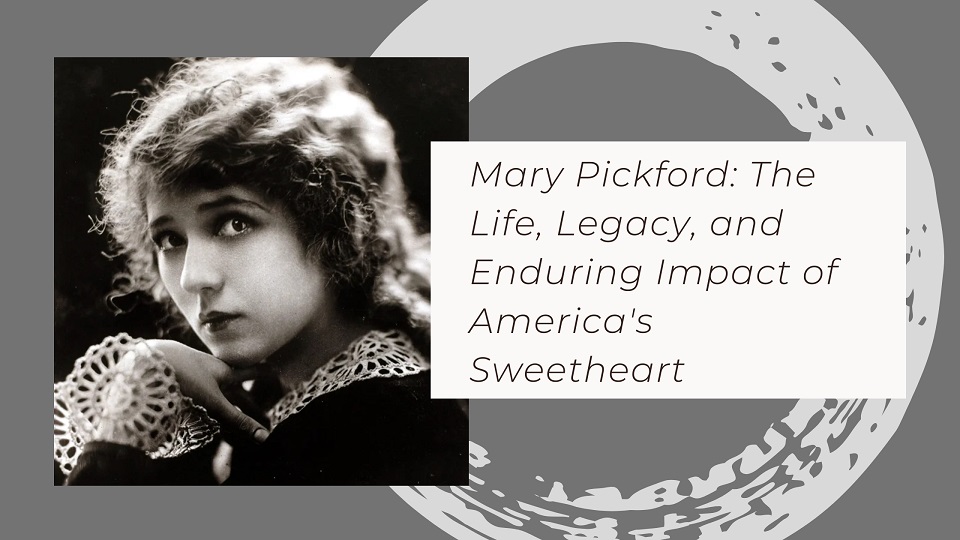
Quick Facts
Born Gladys Louise Smith on April 8, 1892, in Toronto, Ontario, Canada, Mary Pickford was a Canadian-American film actress and producer who became one of the most iconic figures in cinema history. Standing at 5 feet ½ inch (1.54 m) tall, she was known for her petite frame and golden curls that became her trademark. Pickford passed away on May 29, 1979, in Santa Monica, California, at the age of 87. Throughout her career, she amassed an estimated net worth equivalent to roughly $40 million in today’s currency, making her one of the wealthiest women in America during the height of her fame. Her nationality was Canadian by birth and American by naturalization, and her profession encompassed acting, producing, screenwriting, and business leadership. She was famously known by nicknames such as “America’s Sweetheart,” “The Girl with the Golden Curls,” and “The Queen of the Movies.”
Table Of Content
- Quick Facts
- Introduction: Why Mary Pickford Is Famous
- Early Life and Family Background
- Education and Theatrical Beginnings
- Career Journey: From Stage to Screen
- The Biograph Years and Early Film Stardom
- Rise to Superstardom
- The Queen of the Movies: Major Films and Breakthrough Roles
- Co-Founding United Artists and Industry Leadership
- The Transition to Sound and Career Decline
- Achievements and Awards
- Personal Life, Lifestyle, and Family
- Marriages and Relationships
- Family Tragedies
- Lifestyle at Pickfair
- Net Worth and Income Sources
- Physical Appearance and Image
- Interesting Facts About Mary Pickford
- Frequently Asked Questions (FAQ)
- Conclusion: The Enduring Legacy of Mary Pickford
Introduction: Why Mary Pickford Is Famous
Mary Pickford is widely regarded as the world’s first international superstar and one of the most influential figures in the history of American cinema. At a time when the film industry was still in its infancy, Pickford didn’t merely act—she shaped the very foundation of Hollywood as both an artist and a businesswoman. Her unprecedented fame in the silent film era made her one of the most recognizable women on the planet, with statisticians calculating that she was seen by approximately 12 million people globally every single day at the peak of her career.
What truly set Mary Pickford apart was her ability to transcend the role of a performer. She was a pioneer who helped define the ingénue archetype in cinema, co-founded one of the most important film studios in history, and became the first actress to negotiate million-dollar contracts and profit-sharing deals. Her influence extended far beyond the screen—she helped establish the Academy of Motion Picture Arts and Sciences and became a powerful symbol of American culture during World War I. To understand Mary Pickford is to understand the birth of modern celebrity and the transformation of film from a novelty into an art form and global industry.
Early Life and Family Background
Mary Pickford was born Gladys Louise Smith—later baptized as Gladys Marie Smith—into a working-class family in Toronto’s impoverished “The Ward” district. Her father, John Charles Smith, was the son of English Methodist immigrants who struggled with alcoholism and worked a series of odd jobs. Her mother, Charlotte Hennessey, was of Irish Catholic descent and worked as a seamstress. Pickford had two younger siblings who also entered show business: Charlotte, who performed as “Lottie Pickford,” and John Charles Jr., who became known as “Jack Pickford.”
Tragedy struck when Gladys was just five years old. On February 11, 1898, her father died from a cerebral hemorrhage caused by a workplace accident while working as a purser with Niagara Steamship. Pickford would later recall the traumatic moment with haunting clarity, writing, “I can close my eyes and still hear that scream of Mother’s at the moment Father passed on.”
The family was left destitute, and the young Gladys was so traumatized by the event that she did not attend school regularly and struggled to learn to read as a child.
Despite these harsh circumstances, the Smith family found a path forward through performance. Their devoutly Catholic maternal grandmother, Catherine Faeley Hennessey, had the children baptized as Catholics during a household quarantine when Gladys was four. This religious background, combined with their mother’s fierce determination to keep the family together, would shape the values that Pickford carried throughout her life.
Education and Theatrical Beginnings
Gladys Smith’s formal education was limited due to her family’s circumstances and her early entry into show business. She briefly attended McCaul School on University Avenue in Toronto, but her real education came from the stage. In 1898, the same year her father died, seven-year-old Gladys made her theatrical debut playing a fatherless child in the melodrama The Silver King.
From that moment, she and her mother, Charlotte, built a life on the road, touring in various theater productions. Known for a time as “Baby Gladys Smith,” she crisscrossed the country with her family in different theater companies, learning the craft of acting through relentless practice and observation. By the time she was a teenager, she had accumulated more practical knowledge of stagecraft than many actors twice her age.
At age 15, Gladys set her sights on Broadway. She traveled to New York City with an ambitious goal: to work for David Belasco, one of the most celebrated theater impresarios of the era. For weeks, she waited outside his office, enduring repeated rejections. One day, facing yet another refusal, she became strident and insistent. An associate of Belasco, hearing the commotion, opened his door. Gladys marched in and declared, “My life depends on seeing Mr. Belasco!”
Her tenacity—and undeniable beauty—won her an audition.
Belasco cast her in The Warrens of Virginia, which opened on December 3, 1907, at Broadway’s Belasco Theater. It was Belasco who suggested she adopt a stage name. She chose “Mary Pickford”—”Pickford” from her mother’s family and “Mary” adapted from her middle name, Marie (she had told Belasco her middle name was Marie rather than Louise, which she disliked).
Career Journey: From Stage to Screen
The Biograph Years and Early Film Stardom
Mary Pickford’s transition to film was born not from ambition but from necessity. In 1909, after performing in Belasco’s A Good Little Devil, the show folded. At nearly 17, Pickford found herself at a professional crossroads—too old to play children on stage, yet too young to be a leading lady. On her mother’s advice, she turned to what was then considered the lowest rung of the entertainment ladder: motion pictures.
She approached D.W. Griffith at the Biograph Company, one of the leading film studios of the era. Despite a disconcerting screen test and an awkward initial encounter, Griffith was captivated by her beauty, her tumbling blonde curls, and what he described as “the intelligence which shone in her eyes.”
He offered her $5 a day for three days a week. Pickford, already demonstrating the business acumen that would define her career, countered with a demand for $10 a day plus extra pay for additional work. Griffith accepted.
In 1909 alone, Pickford appeared in more than 40 short films for Biograph. She quickly understood that film acting required a different approach than stage performance. She toned down her theatrical gestures, expressing emotion through subtle facial expressions and her remarkably expressive eyes. Audiences responded enthusiastically, and she became known as the “Biograph Girl”—one of the first instances of an actor becoming famous simply for appearing on screen.
Rise to Superstardom
Pickford’s career trajectory was meteoric. With her mother’s guidance as her business manager, she moved strategically between studios, always negotiating higher salaries. In 1911, she briefly joined IMP Film Co. under Carl Laemmle to earn more money before returning to Biograph in 1912. Then, in 1913, she made a landmark deal with Adolph Zukor’s Famous Players Film Company for the then-astonishing salary of $500 a week—more than the average American worker earned in a year.
Her first three films for Famous Players—In the Bishop’s Carriage (1913), Caprice (1913), and Hearts Adrift (1914)—cemented her image in the public imagination: a character who was “half savage, half angel, dressed in tatters, untamable, pugnacious, street-smart,” yet whose virtue ultimately triumphed.
By 1915, her salary had doubled, and she began receiving half the profits from her films—an almost unheard-of arrangement at the time. In 1916, when a competitor offered her $2,000 a week, Zukor countered with $1,000, which she accepted to maintain her working relationship with him. That same year, Mutual studio offered her $1 million annually. Zukor responded with an extraordinary package: half the profits of her films, a $300,000 bonus, her own production unit with full creative control, and a guaranteed minimum of $500,000 a year.
On June 24, 1916, Pickford signed what became known as the “million-dollar contract”—a record-breaking deal that granted her $10,000 a week, half of each film’s profits, and a guarantee of $1.04 million. She became the first actress to sign such a contract and was named vice-president of Pickford Film Corporation.
The Queen of the Movies: Major Films and Breakthrough Roles
Throughout her career, Mary Pickford starred in 52 feature films. While she is often remembered for her “little girl” roles, these represented only one facet of her remarkable range. Some of her most significant films include:
- The Poor Little Rich Girl (1917): One of her most successful films, cementing her ability to play child roles with depth and authenticity.
- Rebecca of Sunnybrook Farm (1917): Another beloved “little girl” performance that resonated deeply with audiences.
- Stella Maris (1918): Considered by many critics to be among her finest work, featuring Pickford in dual roles as both a beautiful invalid and a “misshapen” orphan.
- Daddy-Long-Legs (1919): A major hit and the first film over which she had complete creative control.
- Pollyanna (1920): Grossed approximately $1.1 million (equivalent to over $17 million today) and further solidified her little-girl persona.
- Little Lord Fauntleroy (1921): Another commercial success.
- Rosita (1923): Grossed over $1 million.
- Little Annie Rooney (1925): Featured Pickford again as a child character.
- Sparrows (1926): Blended Dickensian themes with German expressionist style.
- My Best Girl (1927): A romantic comedy featuring her future husband, Charles “Buddy” Rogers.
Co-Founding United Artists and Industry Leadership
In 1919, Mary Pickford made history by co-founding United Artists alongside Charlie Chaplin, Douglas Fairbanks, and D.W. Griffith. This was a revolutionary move—never before had filmmakers taken such control over the business side of their productions. The company was designed to distribute the founders’ films independently, eliminating the distributors’ stranglehold on profits.
“The satisfaction was, in one word, freedom,” Pickford later reflected. “It’s a heady wine, and having tasted it, you find it impossible to go back to working for someone else.”
Pickford also used her industry stature to promote numerous causes. In 1916, she helped found the Hollywood Studio Club with Constance Adams DeMille, providing housing for young women in the motion picture business. After World War I, she conceived the Motion Picture Relief Fund to help financially needy actors, which eventually led to the construction of the Motion Picture Country House and Hospital in 1940.
The Transition to Sound and Career Decline
The arrival of sound in cinema proved challenging for Pickford. She famously underestimated its importance, claiming that “adding sound to movies would be like putting lipstick on the Venus de Milo.”
Her first talkie, Coquette (1929), required a dramatic transformation—her iconic ringlets were cut into a 1920s bob. The haircut made front-page news in The New York Times, as her hair had become a symbol of female virtue to her devoted fans.
Coquette was a commercial success and won her the Academy Award for Best Actress, though the victory was controversial. However, audiences struggled to accept her in more sophisticated adult roles, and like many silent film stars, she found her career fading as talkies became dominant. She retired from acting in 1933 but continued producing.
Achievements and Awards
Mary Pickford’s contributions to cinema were recognized with numerous honors throughout her lifetime:
- Academy Award for Best Actress (1930): For her role in Coquette (1929), making her one of the earliest Oscar winners.
- Academy Honorary Award (1976): Presented for her contributions to American cinema, accepted at her home, Pickfair, as she was too frail to attend the ceremony.
- Founding Member of the Academy of Motion Picture Arts and Sciences (1927): One of only 36 founders of the organization that presents the Oscars.
- First Star at Grauman’s Chinese Theatre (1927): Along with husband Douglas Fairbanks, she was the first star to officially place hand and foot prints in the cement—establishing one of Hollywood’s most enduring traditions.
- AFI Recognition (1999): The American Film Institute named her the 24th-greatest female star of Classical Hollywood Cinema.
- Canada’s Walk of Fame (1999): Received a posthumous star in her native Toronto.
She was also the first movie actress to receive a percentage of a film’s earnings, setting a precedent that would influence Hollywood contract negotiations for generations.
Personal Life, Lifestyle, and Family
Marriages and Relationships
Mary Pickford’s personal life was as dramatic as her films. She married three times:
- Owen Moore (1911–1920): An Irish-born silent film actor and director. The marriage was troubled, and they divorced on March 2, 1920.
- Douglas Fairbanks (1920–1936): The union of America’s two biggest stars captivated the world. They married in 1920 after both divorced their previous spouses, and their romance was celebrated as a real-life fairy tale. They lived in a lavish Hollywood estate called “Pickfair,” which became synonymous with Hollywood glamour and hosted world leaders and cultural icons. Their marriage ended in divorce in 1936, reportedly due to Fairbanks’ infidelities. Tragically, Fairbanks died just six months after their divorce was finalized, at age 56.
- Charles “Buddy” Rogers (1937–1979): A fellow actor who had co-starred with Pickford in My Best Girl (1927). Rogers had pursued her for years, and she finally relented in 1937. This marriage lasted until her death.
Family Tragedies
Pickford experienced profound personal loss. Her younger brother, Jack Pickford, died in Paris in 1933, and her sister, Lottie, died three years later in 1936—both victims of lives marked by alcoholism and abuse.
In 1939, her first husband, Owen Moore, also died at age 56. By the time she was 47, Mary Pickford had lost nearly everyone in her immediate family circle.
In the early 1940s, Mary and Buddy Rogers adopted a boy and a girl, though Pickford reportedly struggled with motherhood and the children eventually distanced themselves from Pickfair.
Lifestyle at Pickfair
Pickfair, the couple’s estate, was the epicenter of Hollywood royalty. Renowned figures from around the world sought audiences with Pickford, including Sherlock Holmes author Arthur Conan Doyle, ballerina Anna Pavlova, and novelists Leo Tolstoy and H.G. Wells.
Despite her conservative political views and her image of fragility and innocence, Pickford proved to be a formidable businesswoman who maintained strict control over her career and finances.
In her later years, Pickford became increasingly reclusive. After approximately 1963, she spent most of her time in bed at Pickfair, and her public appearances became rare. She passed away on May 29, 1979, at the age of 87, from complications following a stroke.
Net Worth and Income Sources
At the height of her career, Mary Pickford was not just a movie star—she was one of the richest women in America. Her income sources were remarkably diverse for her era:
- Film Salaries and Profit Sharing: Her 1916 contract guaranteed her $10,000 a week plus half of all film profits, with a minimum guarantee of over $1 million. She was the first actress to negotiate such terms.
- United Artists: As a co-founder, she shared in the profits of one of Hollywood’s most important studios. In 1956, she sold her share of the company for $3 million.
- Real Estate and Investments: Pickford was known for her financial conservatism and shrewd investments. She and her mother were meticulous about saving and investing earnings.
- Production Control: Through her own production unit, she maintained creative and financial control over her films, maximizing her returns.
Her estimated net worth at the time of her death was approximately $40 million in today’s currency, though some estimates suggest her peak wealth was significantly higher when adjusted for inflation. In 1918 alone, she paid $277,000 in income tax—making her one of the largest personal taxpayers in America at the time.
Physical Appearance and Image
Mary Pickford stood at 5 feet ½ inch (1.54 m), a petite stature that contributed to her ability to convincingly portray children and young girls well into her twenties and thirties. Her weight was typically estimated at around 100 pounds, maintaining a slender, delicate frame that aligned with her “America’s Sweetheart” image.
Her most famous physical attribute was her mass of golden curls, which became a symbol of female virtue and innocence in early 20th-century America. When she cut her hair in 1928 following her mother’s death, the act made front-page news and shocked her devoted fanbase. Her expressive eyes were frequently cited by directors and critics as her most powerful feature—D.W. Griffith was particularly struck by “the intelligence which shone in her eyes.”
Pickford’s naturalistic acting style, combined with her diminutive size and youthful appearance, allowed her to create a screen persona that felt both accessible and aspirational. She rarely relied on heavy makeup or elaborate costumes, preferring a more natural look that audiences found refreshingly genuine.
Interesting Facts About Mary Pickford
- Age Deception: Throughout her life, Pickford led many people to believe she was a year younger than her actual age. This began in childhood to make her appear more of an acting prodigy and continued so she could be cast in younger roles. Her birth plaque in Toronto lists her birth year as 1893 rather than 1892.
- Film Preservation: She originally intended to have all of her films destroyed after her death, fearing no one would care about them. She was convinced not to do so, preserving an invaluable part of cinema history.
- War Effort: During World War I, she was instrumental in selling liberty bonds. In a single speech in Chicago, she sold an estimated $5 million worth of bonds, and one of her famous curls was auctioned for $15,000. The U.S. Navy christened her their official “Little Sister,” and the Army named two cannons after her.
- The “Bank of America’s Sweetheart”: Charlie Chaplin, despite finding her business acumen “unseemly in a woman,” nicknamed her the “Bank of America’s Sweetheart” due to her extraordinary financial savvy.
- First International Superstar: In 1915, statisticians calculated she was seen by 12 million people daily worldwide—the first person to achieve such global recognition through film.
- Toronto Legacy: Her birth home on University Avenue was demolished in 1943, but 20 bricks were sent to her in California. A bust and historical plaque now mark her birthplace, which is now the site of the Hospital for Sick Children.
- Conservative Politics: Unlike many of her Hollywood peers, Pickford held conservative political views and was initially neutral about World War I before becoming an enthusiastic supporter of the American war effort.
Frequently Asked Questions (FAQ)
How old was Mary Pickford when she died?
Mary Pickford passed away on May 29, 1979, at the age of 87. She was born on April 8, 1892, in Toronto, Canada.
What was Mary Pickford’s net worth?
At the height of her career, Mary Pickford was one of the richest women in America, with an estimated net worth equivalent to approximately $40 million in today’s currency. She was Hollywood’s first millionaire by 1916 and earned record-breaking salaries, including a guaranteed minimum of over $1 million annually at her peak.
What was Mary Pickford’s real name?
Her birth name was Gladys Louise Smith, later baptized as Gladys Marie Smith. She adopted the stage name Mary Pickford in 1907 at the suggestion of Broadway producer David Belasco.
What are Mary Pickford’s most famous works?
Her most celebrated films include The Poor Little Rich Girl (1917), Rebecca of Sunnybrook Farm (1917), Stella Maris (1918), Daddy-Long-Legs (1919), Pollyanna (1920), Little Lord Fauntleroy (1921), Sparrows (1926), and her Oscar-winning talkie Coquette (1929).
Who was Mary Pickford married to?
She was married three times: first to actor Owen Moore (1911–1920), then to fellow superstar Douglas Fairbanks (1920–1936), and finally to actor Charles “Buddy” Rogers (1937–1979).
Why was Mary Pickford called “America’s Sweetheart”?
The nickname reflected her image as the innocent, virtuous, golden-haired girl next door that she portrayed in countless films. Despite being Canadian by birth, she became a powerful symbol of American culture and values during the silent film era.
What was Mary Pickford’s height?
Mary Pickford stood at 5 feet ½ inch (1.54 m) tall. Her petite stature was one of the factors that allowed her to convincingly portray child and teenage roles well into adulthood.
What is Mary Pickford’s legacy today?
She is remembered as the world’s first international superstar, a pioneering businesswoman who co-founded United Artists and helped establish the Academy of Motion Picture Arts and Sciences, and one of the most influential figures in the history of cinema. The American Film Institute ranks her as the 24th-greatest female star of Classical Hollywood Cinema.
Conclusion: The Enduring Legacy of Mary Pickford
Mary Pickford’s impact on cinema and popular culture cannot be overstated. She was more than an actress—she was an architect of the modern entertainment industry. From her early days as “Baby Gladys” touring the Canadian countryside to her reign as “The Queen of the Movies,” Pickford demonstrated that talent, determination, and business acumen could transform not just a life but an entire art form.
She pioneered the concept of the actor as an independent business entity, negotiating contracts and profit-sharing deals that set precedents still felt in Hollywood today. Through United Artists, she helped establish the principle that creative artists should control their own work. Through the Academy of Motion Picture Arts and Sciences, she helped create the institution that would honor cinematic achievement for generations.
Yet her legacy is also a cautionary tale about the nature of fame. She was the first to experience both the intoxicating heights of global celebrity and the devastating loneliness of its decline. As the silent era ended and her personal life unraveled with the deaths of her siblings, her mother, and Douglas Fairbanks, Pickford retreated into the seclusion of Pickfair, eventually becoming a recluse.
When she received her honorary Oscar in 1976, audiences were shocked to see how much she had aged—a reminder of how frozen she remained in the public imagination as the eternal golden-haired girl. She died three years later, but her influence endures. In 1999, the American Film Institute recognized her as one of the greatest stars of Classical Hollywood Cinema, and her films continue to be studied and celebrated as foundational works of the medium.
Mary Pickford proved that a young girl from the poor districts of Toronto could not only conquer the world but reshape it. Her story is one of resilience, innovation, and the complex price of being the first to achieve what no one had done before.